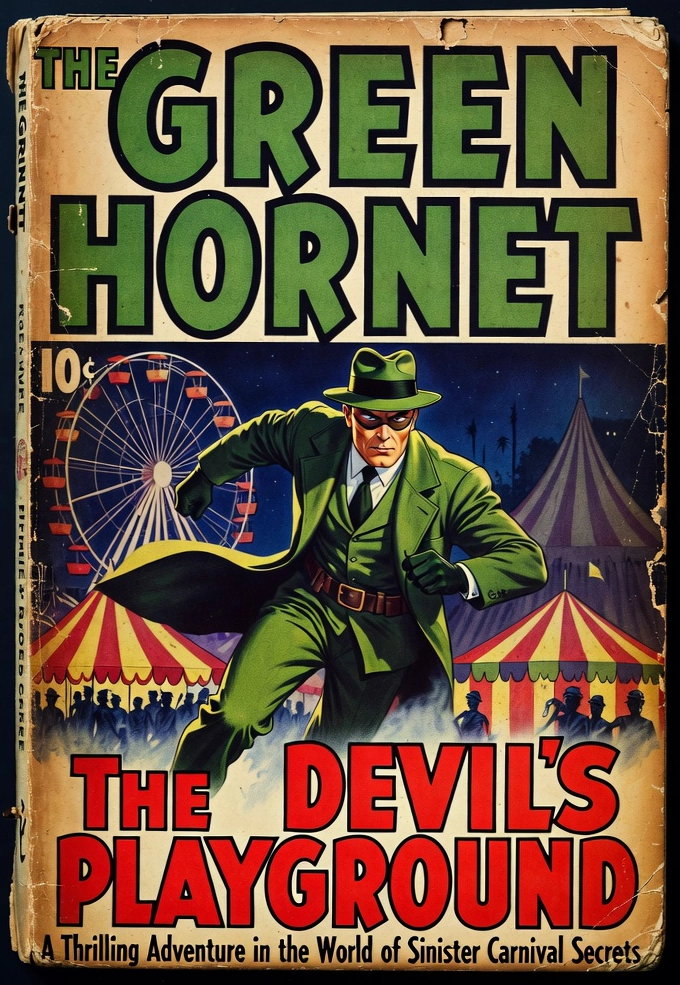
The Green Hornet
A Crimefighter Built From the Ground Up
The Green Hornet didn't arrive fully formed. It was assembled piece by piece — the color of the costume debated, the buzzing sound chased through hotel-room memories, the hero's name checked against existing rights — by a producer who knew exactly what he wanted and was willing to fuss over every detail until he got it. When it finally premiered on January 31, 1936, on WXYZ in Detroit, the show that emerged was something carefully engineered rather than casually invented.
That producer was George W. Trendle, who by 1935 already had The Lone Ranger running smoothly out of WXYZ and was looking for a companion. He pulled in writer Fran Striker and Lone Ranger director James Jewell, and the three of them gradually worked out the concept: a modern urban crimefighter who operated in the same moral space as the Lone Ranger — fighting for the law while being hunted by it. The setting shifted from the frontier West to a contemporary city, and the masked man traded his horse for an automobile, but the underlying structure was familiar.
What drove the theme was partly Trendle's own preoccupations. According to writer Dick Osgood, who worked at WXYZ for 36 years and wrote the station's unofficial history, Wyxie Wonderland, Trendle wanted to dramatize the idea that a political system could be riddled with corruption and that one determined man could fight white-collar lawlessness successfully. That's a narrower and more specific premise than most radio adventure shows of the era, and it shaped the kinds of villains Britt Reid went after week after week.
The Family Connection
One of the more unusual design decisions behind the show was the link it built to The Lone Ranger. The Green Hornet's mythology positioned the Lone Ranger as Britt Reid's great-uncle. The character who appeared as a very young boy in Lone Ranger episodes — Dan Reid, nephew of John Reid — grew old and eventually fathered Britt. John Todd, who played Dan Reid on The Lone Ranger, made occasional appearances on The Green Hornet to reinforce that thread.
Britt Reid himself was set up as the publisher of a Detroit newspaper, the Daily Sentinel, a role his father Dan installed him in partly to prevent the young playboy from being frivolous. Along with the publisher's job came Michael Axford, a former cop brought in as bodyguard and overseer — a character Trendle lifted wholesale from an earlier WXYZ melodrama called Warner Lester, Manhunter, which he was discontinuing. Axford eventually became a Sentinel reporter, but the show played him throughout as a comic figure of limited intelligence whose driving ambition was to capture the Green Hornet. He never managed it.
The rest of the Sentinel staff filled out the world. Ed Lowry was the paper's top reporter, digging up the stories that Reid would ultimately expose. Lenore Case — "Casey" to Axford, always "Miss Case" to Reid — served as secretary and the show's understated love interest. Trendle shows carried almost no romance, and that applied here: Casey eventually moved up to writing the society page, but any suggestion of a relationship with Reid stayed well in the background.
Kato and the Arsenal
Britt Reid's valet, Kato, was described on air as a Filipino who was "the only living man to know him as the Green Hornet." Tokutaro Hayashi, who originated the role, was renamed Raymond Toyo by director James Jewell for professional reasons. Kato wasn't simply a driver. The show characterized him as a master chemist who designed the gas guns and smokescreens in the Green Hornet's arsenal, an expert in Oriental combat, a college graduate, cook, housekeeper, and the man behind the wheel of the Black Beauty — the Green Hornet's automobile, filling the same narrative role that Silver the horse filled on The Lone Ranger.
A persistent rumor claimed that Kato was originally written as Japanese and quietly made Filipino after the attack on Pearl Harbor in December 1941. The evidence suggests otherwise: Kato was described as a Filipino of Japanese descent at least two years before that date.
The Green Hornet's base of operations was reached through a secret panel in Britt Reid's bedroom, down a narrow passage inside the wall, down creaking steps to an abandoned-looking building on a dead-end side street. The show kept those atmospheric details consistent across its long run, grounding the character in a specific and somewhat shadowy physical world.
The Sound of the Show
Trendle was obsessed with a buzzing sound. He remembered bees from a hotel room where he had once stayed and wanted that specific quality built into the show. Osgood wrote about the considerable effort soundmen were put through trying to re-create what Trendle had in mind. What they eventually landed on was the Theremin, an instrument rarely used in radio production, to generate the Hornet's distinctive buzz. Paired with the theme — Rimsky-Korsakov's "Flight of the Bumblebee," performed with heavy violin emphasis — it gave the show a sonic identity that was genuinely distinctive.
Classical music was used throughout the program for bridges between dramatic acts, not just for the opening and closing. The show's 1939 signature line captured the premise directly: "He hunts the biggest of all game! Public enemies that even the G-men cannot reach!" That line didn't survive long. FBI director J. Edgar Hoover reportedly complained about it, and it was revised to: "He hunts the biggest of all game! Public enemies who try to destroy our America!" The full character description ran: "Britt Reid, daring young publisher, matches wits with the underworld, risking his life that criminals and racketeers within the law may feel its weight by the sting of the Green Hornet!"
Each episode closed with a newsboy — played by Rollon Parker — hawking headlines about the Green Hornet's latest success, signing off with lines like: "Special extry! Paper! Police smash smuggling racket! Foreign diplomat involved! Read all about it! Green Hornet still at large!"
Recurring Foes and a Rare Confession
For most of its run the show treated Britt Reid's secret as inviolable — Axford never figured it out, Casey never figured it out, and most antagonists came and went within a single episode. The notable exception was Oliver Perry, billed as "The Great Detective," a famous private investigator who first appeared in the December 26, 1944 episode "The Great Detective" suspecting a link between the Daily Sentinel and the Green Hornet. Perry kept coming back — "The Last of Oliver Perry" in February 1946, "Oliver Perry Tries Again" that September, "The Travis Case" in May 1948, "Oliver Perry Closes In" in May 1949 — each appearance bringing him a little nearer the truth, until "Oliver Perry – Escaped Convict" in November 1949 finally returned him to prison for good.
The show also broke its own secrecy rule from the inside. In "Too Hot to Handle" on November 11, 1947, Britt told his father Dan that he was the Green Hornet, with the Lone Ranger theme briefly playing under the scene as Dan expressed pride in his son. The following week, in "The Man on Top," father and son together confided the secret to Police Commissioner James Higgins, an old friend of Dan's who had been introduced the prior episode as a blackmail victim. For a show that mostly reset each week, that two-part stretch was an unusual moment of genuine continuity.
The Cast Over Sixteen Years
The show ran a long time — from 1936 to December 5, 1952 — and the cast turned over accordingly. Al Hodge played Britt Reid from the beginning through 1943, when he entered military service. Donovan Faust stepped in briefly during 1943, Bob Hall took the role from 1944 to 1951, and Jack McCarthy carried it through the final year. Rollon Parker and later Michael Tolan followed Raymond Toyo in the role of Kato. Leonore Allman played Casey throughout. Jim Irwin originated Michael Axford, and when Irwin died in 1938, Gilly Shea took over the part and continued in it.
Announcers included Fielden Farrington, Charles Wood, a young Mike Wallace, Hal Neal, and Bob Hite. Writers who worked on the show at various points included Fran Striker, Dan Beattie, Leo Boulette, Steve McCarthy, Tom Dougall, Lee Randon, and Jim Lawrence. The show was directed at different times by James Jewell and Charles Livingstone, and the elaborate sound effects were handled by a rotating crew at WXYZ that included Tony Caminito, Dewey Cole, Jimmy Fletcher, Fred Flowerday, Fred Fry, Bill Hengsterbeck, and Ken Robertson.
The Network Run
After originating on WXYZ with local Detroit sponsors — United Shirt Shops and Detroit Creamery — the show moved to the Mutual network in April 1938 and then to the Blue Network, which became ABC, in November 1939. That Blue Network–ABC run lasted until the final broadcast on December 5, 1952, and was largely sustained, meaning it ran without a paying sponsor for most of those years. General Mills came on as a sponsor from January through August 1948, and Orange Crush picked it up for the final stretch from September through December 1952.
For most of its ABC years the show landed in the late afternoon or early evening, somewhere between 4:30 and 8:30, sometimes twice a week. It ran continuously with very few interruptions from November 1939 through September 1950, went dark briefly, and returned for a final run from September 1950 through the December 1952 close. It was produced and originated at WXYZ throughout its entire run, fed out to the networks from Detroit rather than from New York.
Serials, Books, and the Long Afterlife
The radio show spawned spin-offs almost from the beginning. Universal Pictures produced two movie serials in 1940 — the thirteen-chapter The Green Hornet and the fifteen-chapter The Green Hornet Strikes Again!, released later that December. Gordon Jones played Britt Reid on camera in the first, Warren Hull took over for the second, but in both cases Al Hodge's radio voice was dubbed in whenever the hero's mask was in place. Keye Luke played Kato in both serials, with Kato's nationality reassigned to Korean to sidestep rising anti-Japanese sentiment. The Black Beauty in the serials was a 1937 Lincoln Zephyr, not the Chrysler Imperial that later became iconic on television.
Print followed quickly. Whitman Books released three Big Little Books attributed to Fran Striker — The Green Hornet Strikes! (1940), The Green Hornet Returns (1941), and The Green Hornet Cracks Down (1942). Comic books began in December 1940 under Helnit/Holyoke, also with Striker-credited scripts, and Harvey Comics took over the title with issue #7, continuing through issue #47 in 1949. Dell published a one-shot in 1953, and Gold Key produced a three-issue series tied to the 1966 television show.
Television itself took longer. Trendle pitched a Green Hornet TV series in 1951 and again in 1958, and neither attempt found a buyer. The 1954 sale of The Lone Ranger to Jack Wrather complicated matters further: the family connection that had been central to the radio mythology could no longer be made explicit in later Green Hornet adaptations. When the property finally reached television, it was through producer William Dozier's ABC series that premiered September 9, 1966, with Van Williams as Britt Reid and Bruce Lee as Kato. Dozier played it straight rather than in the campy style of his concurrent Batman; the theme was Rimsky-Korsakov's "Flight of the Bumble Bee" in an Al Hirt arrangement. Lee insisted that Kato be portrayed as a real martial artist, and the show became the first mainstream American exposure many viewers had to genuine martial arts fighting. In Hong Kong, where Lee had been raised, his popularity was such that the series was marketed as The Kato Show. The Green Hornet and Kato also crossed over to Batman itself, in the two-part "A Piece of the Action" and "Batman's Satisfaction" on March 1 and 2, 1967. ABC canceled the show after 26 episodes; the last original broadcast aired March 17, 1967.
The property has kept moving since — a 2011 Columbia feature with Seth Rogen and Jay Chou, ongoing comic-book licensing to Dynamite Entertainment in the 2010s — but its core was built in a Detroit radio station in the mid-1930s, by a producer who wouldn't settle for any buzz but the right one.